What Is the maximum run length for a single high voltage LED strip? The answer is rarely printed as one universal number. It depends on input voltage, wattage per metre, copper thickness, rectifier design, connector resistance, and installation temperature. A 230V strip may reach 25 to 50 metres, while some products stop at 10 or 20 metres. The manufacturer’s tested limit remains decisive.
The U.S. Department of Energy’s Solid-State Lighting reports show continuing gains in LED efficacy and system performance. However, efficiency does not remove voltage drop. The IEA 4E Solid State Lighting Annex also stresses the importance of quality drivers, thermal management, and reliable installation practices. These findings matter on a real ceiling. A long strip can appear bright near the power feed, then visibly weaken at the far end. Heat makes the problem worse.
Lighting engineer David C. Smith offers a useful field rule: “The maximum run length is determined by the entire electrical path, not the strip alone.” That principle deserves attention. Check the product datasheet, measure the strip’s wattage, and confirm the stated maximum length. Do not trust a neat number on a sales page. In practice, some installers shorten the run by 10 to 20 percent for extra stability. That is not always necessary, but it is often sensible. The overlooked detail is power injection. A high-voltage strip may run farther, yet its connectors and rectifier can still become weak points. Always test the full length before permanent installation.
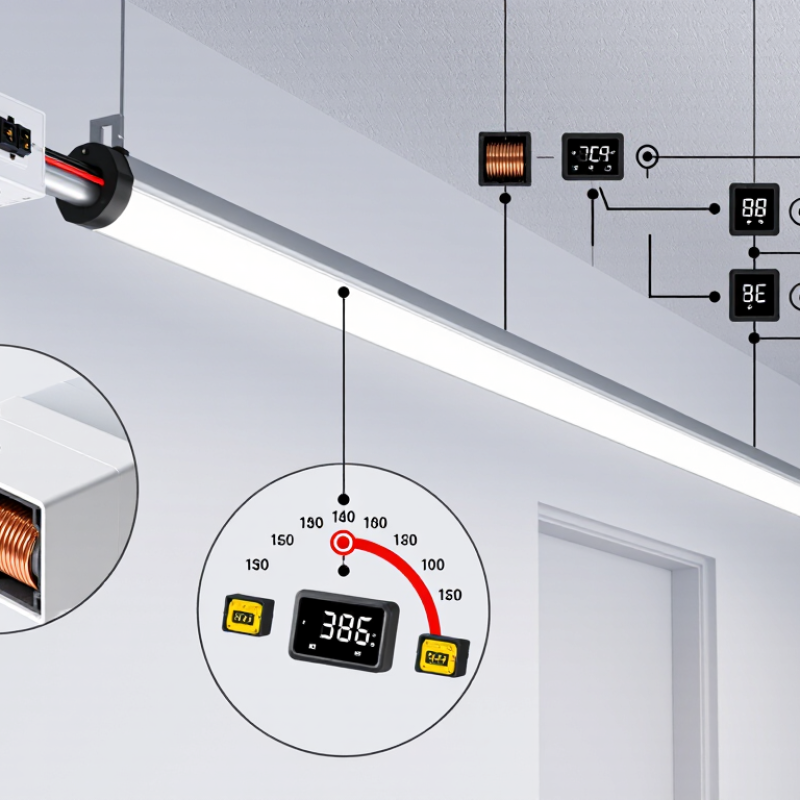
What Defines the Maximum Run Length of a High-Voltage LED Strip?
The maximum run length of a high-voltage LED strip is not defined by voltage alone. It depends on voltage drop, conductor size, LED density, strip construction, and driver capacity. Voltage drop increases as the strip becomes longer. The farthest LEDs may then appear dimmer or slightly warmer in color. A simple distance chart can mislead. It may assume ideal conditions, clean connections, and a stable indoor temperature.
Ambient heat also matters. A strip installed inside a narrow aluminum channel may cool differently from one mounted on an open ceiling. Higher LED density usually creates greater power demand. The same length can therefore perform differently across two installations. Real conditions matter.
An experienced installer checks the strip’s rated wattage per meter and calculates the total load before cutting. The power supply should have suitable reserve capacity, not run continuously at its limit. I also inspect the voltage at both ends during operation. If the far end shows a noticeable voltage loss, the run may be too long for that layout. Shorter sections can improve consistency. Power injection may help, but it cannot correct poor connectors, undersized wiring, or excessive heat. Local electrical requirements must also be followed, especially in damp or exposed areas. A qualified electrician should verify high-voltage connections. Sometimes, the safest maximum is shorter than the advertised maximum.
How Voltage Drop Limits High-Voltage LED Strip Length
What Is the Maximum Run Length for a High Voltage LED Strip?
How Voltage Drop Limits High-Voltage LED Strip Length
A high-voltage LED strip usually operates at 120V or 230V AC. Its lower current reduces voltage drop across long cable sections. For example, a 96-watt, 230V strip draws about 0.42 amps. A 24V version needs 4 amps. This difference matters. The U.S. Department of Energy’s Solid-State Lighting reports identify electrical and thermal management as key LED design priorities. However, voltage is not the only limit. Internal rectifiers, resistor spacing, heat, and factory-tested segment lengths can restrict the run. Many products allow 50 or 100 meters, but that is not a universal rule.
Consider a 24V, 9.6W-per-meter strip running 10 meters. Its current reaches 4 amps. IEC 60228 lists approximately 7.41 ohms per kilometer for a 2.5 mm² copper conductor. A 20-meter circuit loop creates about 0.15 ohms of resistance. The calculated loss is about 0.6 volts, or 2.5%. Many installers use a 3–5% voltage-drop target, though this remains a practical convention, not a guarantee. Real results can be worse because the strip’s thin copper paths add resistance. The estimate is useful, but imperfect.
Tips: Check the tested maximum length, input voltage, wattage per meter, and ambient temperature. Measure the far-end voltage under load. If brightness fades, shorten the run or add approved injection points. Never assume a longer strip is safer because it uses higher voltage. Follow the installation instructions and local electrical requirements.
Typical Maximum Lengths for Different High-Voltage LED Strips
What Is the Maximum Run Length for a High Voltage LED Strip?
Typical maximum lengths vary with voltage, power density, insulation, and the control method. A 120V AC LED strip commonly supports 30–50 meters per feed. Some 230V AC versions reach 50–100 meters. These figures usually come from product specification surveys, not one universal engineering rule. The U.S. Department of Energy’s Solid-State Lighting R&D Opportunities report (2023) emphasizes efficacy and thermal management, but it does not define a standard strip length.
Lower current helps.
A 10-meter, 120V strip drawing 4 watts per meter uses about 0.33 amps. The same 10-meter load at 24V would draw about 1.67 amps, creating greater voltage-drop risk. However, heat still matters. In enclosed channels, dense 2835 or 5050 layouts may require shorter runs, even at high voltage. IEC 60598-1:2020 and UL 2388:2023 highlight insulation, temperature, and electrical protection requirements for lighting products. They do not make a 50-meter installation automatically safe.
For reliable brightness, designers often divide a stated 50-meter maximum into 10–20-meter sections. Separate rectifiers or feeds can reduce end-of-run dimming. The cutting interval also affects planning, sometimes every 0.5 or 1 meter. A longer run looks efficient on paper. It may perform poorly in a warm ceiling cavity. Check the actual current rating, ambient temperature, mounting surface, and approved connection method before choosing the maximum length.
How to Calculate and Safely Install the Maximum Run Length
What Is the Maximum Run Length for a High Voltage LED Strip?
How to Calculate and Safely Install the Maximum Run Length
There is no universal maximum run length for a high-voltage LED strip. The real limit depends on voltage, wattage, conductor resistance, heat, and the manufacturer’s tested specification. The U.S. Department of Energy’s 2023 Solid-State Lighting Technology Report notes that commercial LED systems commonly exceed 100 lumens per watt. Higher efficacy can reduce current, but voltage drop still limits long installations.
Use this conservative calculation: Lmax = Vdrop ÷ (I × R). For a 120-volt strip drawing 10 watts per meter, a 20-meter run consumes 200 watts, or about 1.67 amps. A three-percent voltage-drop allowance equals 3.6 volts. The total loop resistance should remain below about 2.16 ohms. Include both the supply cable and the strip’s internal resistance. A clean calculation can still mislead when the strip contains uneven copper paths.
Tips: Check the datasheet’s tested maximum before cutting. Measure voltage at the far end under load. Keep connectors tight and protected from moisture. Use the correct fuse, cable size, and controller rating. Follow IEC 60598-1 guidance and local electrical requirements. Never connect or cut an energized strip. Heat matters. A crowded aluminum channel can shorten service life, even when voltage readings look acceptable.
Maximum Run Length for a High-Voltage LED Strip
Estimated continuous run length before reaching a 2% voltage drop, calculated for a 120 V or 230 V system using 1.0 mm² copper conductors and a two-conductor loop resistance of approximately 0.035 Ω/m. Actual limits depend on the LED strip design, rectifier spacing, ambient temperature, installation method, and local electrical regulations.
How to use this chart: Higher-wattage strips produce more current and therefore have a shorter calculated run length. For safe installation, stay below the product-rated maximum, use the correct high-voltage rectifier and connectors, provide strain relief, and verify voltage drop under real operating conditions.
Conclusion
The maximum run length of a high-voltage LED strip depends on its voltage, power consumption, LED density, strip design, and installation conditions. A higher operating voltage generally allows longer continuous runs with less current and reduced voltage drop, but every strip still has a practical limit. What is the maximum run length for a single high voltage LED strip? In many cases, it may range from several meters to dozens of meters, but the manufacturer’s electrical specifications should always be used as the final reference.
Voltage drop can cause dimming, color changes, uneven brightness, or excess heat near the connection point. To determine a safe run length, calculate the strip’s total wattage, confirm the power supply has sufficient capacity, and consider ambient temperature, wiring size, mounting surface, and ventilation. Longer installations may require separate power feeds, multiple sections, or expansion connectors rather than one uninterrupted run. Careful planning, correct polarity, secure connections, and appropriate insulation help ensure consistent performance and safe operation.
 Zionsville Lighting
